
Brand Film vs. Social Media Content: Which One Does Your Business Actually Need?
The false choice most businesses make: they either invest in one big video and expect it to do everything, or they churn out social content with no strategic anchor. The real question isn't which is better, it's understanding what each one actually does. A brand film and social media content are not competing options, they operate at completely different layers of your marketing.
I. What We're Actually Talking About
1. What Is a Brand Film?
A brand film is a longer-form video (typically anywhere from 90 seconds to several minutes) whose primary purpose is to communicate who you are, not what you sell. It's built around emotion, narrative, and visual identity. It answers the question your audience is quietly asking before they decide to work with you: do I trust these people, and do I believe in what they stand for?
A brand film lives on your website homepage, gets shared in pitch decks, plays at events, and anchors your overall visual identity. It's not designed to go viral. It's designed to last.
2. What Is Social Media Video Content?
Social media video content is short-form, platform-native, and built for attention spans measured in seconds. It lives on Instagram, TikTok, LinkedIn, or YouTube Shorts. It can be behind-the-scenes footage, a quick tip, a client testimonial clip, a product showcase, or a reactive piece of content tied to a trend or moment.
Unlike a brand film, social content is designed to be consumed quickly, repeatedly, and often without sound. It prioritizes immediacy over depth, and consistency over perfection.
3. The Key Differences at a Glance
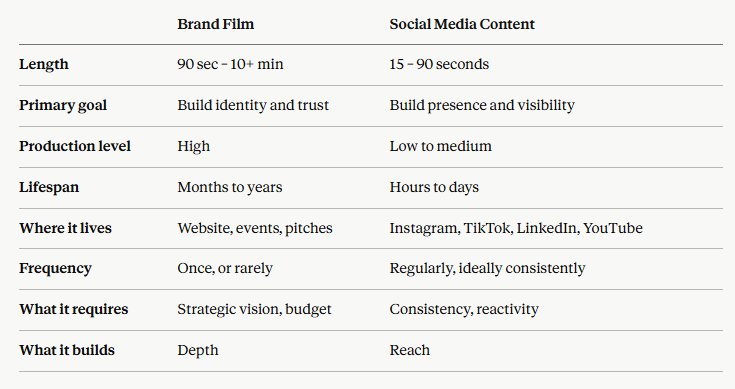
II. What Each One Does for Your Business
1. What a Brand Film Does That Social Content Can't
A brand film buys you something that no amount of short-form content can replicate: meaning. It gives your audience a reason to care before they've ever spoken to you.
Patagonia is the clearest example of this. Their long-form documentaries (180° South, DamNation …) are the foundation of the entire brand identity. The films don't sell jackets. They sell a worldview: environmental activism, adventure, and a fundamental distrust of consumerism. Everything else, social content, product pages, campaigns, follows from that foundation. Without the films, Patagonia is just an outdoor clothing brand.

Volvo did something similar with The Epic Split. One cinematic film, Jean-Claude Van Damme doing the splits between two reversing trucks at sunrise, generated over 100 million YouTube views and defined Volvo's engineering precision story for years. A single, well-executed brand film can do more for long-term brand perception than months of social content.
This is what a brand film does that social content structurally cannot: it holds still long enough to say something. Social content moves too fast, disappears too quickly, and competes with too much noise to carry the full weight of your brand identity alone.
For a business, this matters most at high-stakes moments: a new client considering working with you, a potential partner researching your company, a journalist writing about your industry. In those moments, a brand film speaks for you when you're not in the room.
2. What Social Content Does That Brand Film Can't
A brand film, no matter how good, cannot keep you present. It cannot respond to a trend, show what happened at your event last week, introduce a new team member, or remind your audience that you exist on a Tuesday afternoon in November.
That's what social content does. And for many businesses, this kind of steady, low-stakes visibility is actually more valuable day-to-day than any single polished production.
Duolingo on TikTok is the most striking example. No brand film. No cinematic production. Just a chaotic green owl mascot, reactive humor, and an instinctive understanding of platform behavior. Duolingo built one of the most recognizable brand voices of the past few years on pure social-first strategy; proof that depth isn't always the entry point. Sometimes reach and personality come first.
Glossier did something quieter but equally effective in its early years. Before investing in any polished production, the brand grew almost entirely through Instagram, user-generated content, and behind-the-scenes glimpses into product development. The audience felt like insiders. That intimacy built through consistent, unpolished social content created a loyalty that a brand film alone could never have generated.
Social content also does something a brand film can't in terms of feedback. When you post consistently, you learn what resonates, what questions your audience keeps asking, and what language they use to describe your work. That intelligence makes everything else, including a future brand film, sharper.
3. Why Using One to Replace the Other Usually Fails
The business that produces a beautiful brand film and then goes quiet on social has depth without presence. The film exists, but no one is regularly reminded to watch it. It sits on a homepage, slowly aging.
The business that posts social content every week but has never invested in a brand film has presence without depth. People see them, but don't know what they stand for. The content is easy to consume and equally easy to forget.
Apple's "Shot on iPhone" campaign is interesting precisely because it sits at the intersection of both. What began as a brand film concept, a cinematic celebration of mobile photography, was built almost entirely from user-generated social content. The two formats fed each other: social content gave the campaign its authenticity and scale; the brand film gave it visual ambition and emotional weight. Neither would have worked as well alone.
Most businesses can't execute something at that scale. But the underlying logic applies at any size: a brand film gives your audience something to believe in; social content gives them a reason to keep paying attention. When one is missing, the other has to work too hard…and usually falls short.
Part III. How to Choose (Or Combine Both)
The honest answer depends less on budget and more on what your business actually needs right now.
→ If people who discover you have no idea what you do or why it matters, if your website feels thin, if sales conversations start from zero every time: you probably need a brand film first. You need something that establishes the foundation before anything else.
→ If you already have credibility and a clear identity but you're invisible between projects, if clients know you're good but forget to refer you: you need consistent social content more than another polished production.
A brand film makes the most sense at turning points: launching or repositioning, entering a new market, pitching larger clients. It's a long-term asset, the kind that pays off over months and years. It's also the right choice when what makes your business different has to be felt rather than explained, the atmosphere of a space, the culture of a team, the precision of a craft.
Social content makes sense when you're building an audience from scratch, when your budget is limited, or when your business depends on consistent visibility. It's also the right starting point if you're still figuring out your brand voice: posting regularly forces a clarity that a single production rarely does. If you're not sure what your brand film would even say yet, social content is how you find out.
Most established businesses eventually need both, just not at the same time or scale.
Nike is the clearest example: Just Do It films and cinematic campaigns give the brand its emotional weight, while social content keeps it present and reactive day-to-day. The two work at different layers of the funnel without competing.
Airbnb does the same thing differently: cinematic brand films built around belonging and human connection give the brand its depth, while an active social presence driven by user-generated content and community stories keeps it alive between campaigns.
A practical approach for smaller businesses: start with a brand film that anchors your identity, then build a social strategy that draws from it. Clips, behind-the-scenes, stories that extend the same themes in a shorter format. The film becomes a creative reference point, not just a one-off deliverable.
Bonus: A Note on Budget
Brand films and social content don't compete for the same budget because they don't serve the same purpose. A brand film is a one-time investment with a long lifespan, typically starting around $3,000–$5,000 for a small business production and scaling up significantly depending on scope. Social content is a recurring cost, whether that's your own time or a recurring production arrangement.
The question isn't which is more expensive. It's which one your business is currently missing and what it's costing you not to have it.
You don't have to choose between being credible and being visible. The businesses that do video well tend to invest in both, sequentially if not simultaneously, using each format for what it actually does best.
If you're not sure which one fits your business right now, let's talk. Sometimes fifteen minutes of conversation is enough to figure it out!
